Develop data models collaboratively in the cloud and share them with your organization in various modeling styles and formats with no coding or conversion required
Create and manage business metadata using a dedicated project role
Track and get notified of schema changes in live database environments

The Data Warrior, Strategic Advisor, Data Vault Master, Author, Speaker, and Tae Kwon Do Grandmaster

Leading organizations through analytics transformations, preference for social missions, healthcare, energy, education, and civic engagement
Develop data models collaboratively in the cloud and share them with your organization in various modeling styles and formats with no coding or conversion required
Create and manage business metadata using a dedicated project role
Track and get notified of schema changes in live database environments
Accurate, trusted, and accessible data drives every decision at Pie Insurance, from underwriting to claims management to new business expansion.
Pie’s data engineering team has built trust in Pie’s data by developing a new enterprise data warehouse (EDW2) which has placed health-of-the-business reports and dashboards at the fingertips of Executives and Business Analysts across the company. Stakeholders trust this data and use it as a foundation for pricing optimizations, underwriting decisions, resource allocations, and claims management.
This interview with Ed Presz (Director of Data Engineering) and Ken Wood (Staff Data Engineer) highlights how Pie transformed into a data-first culture, positioning Pie’s data capabilities as a competitive edge in the insurance industry. SqlDBM for data modeling and architectural oversight has been key to this success.
Ed leads Pie’s data engineering organization, spanning architecture, analytics, data platform, and machine learning engineering. But his role is bigger than just managing teams. Ed says his leadership philosophy is rooted in a simple truth: “Our data is the product.”
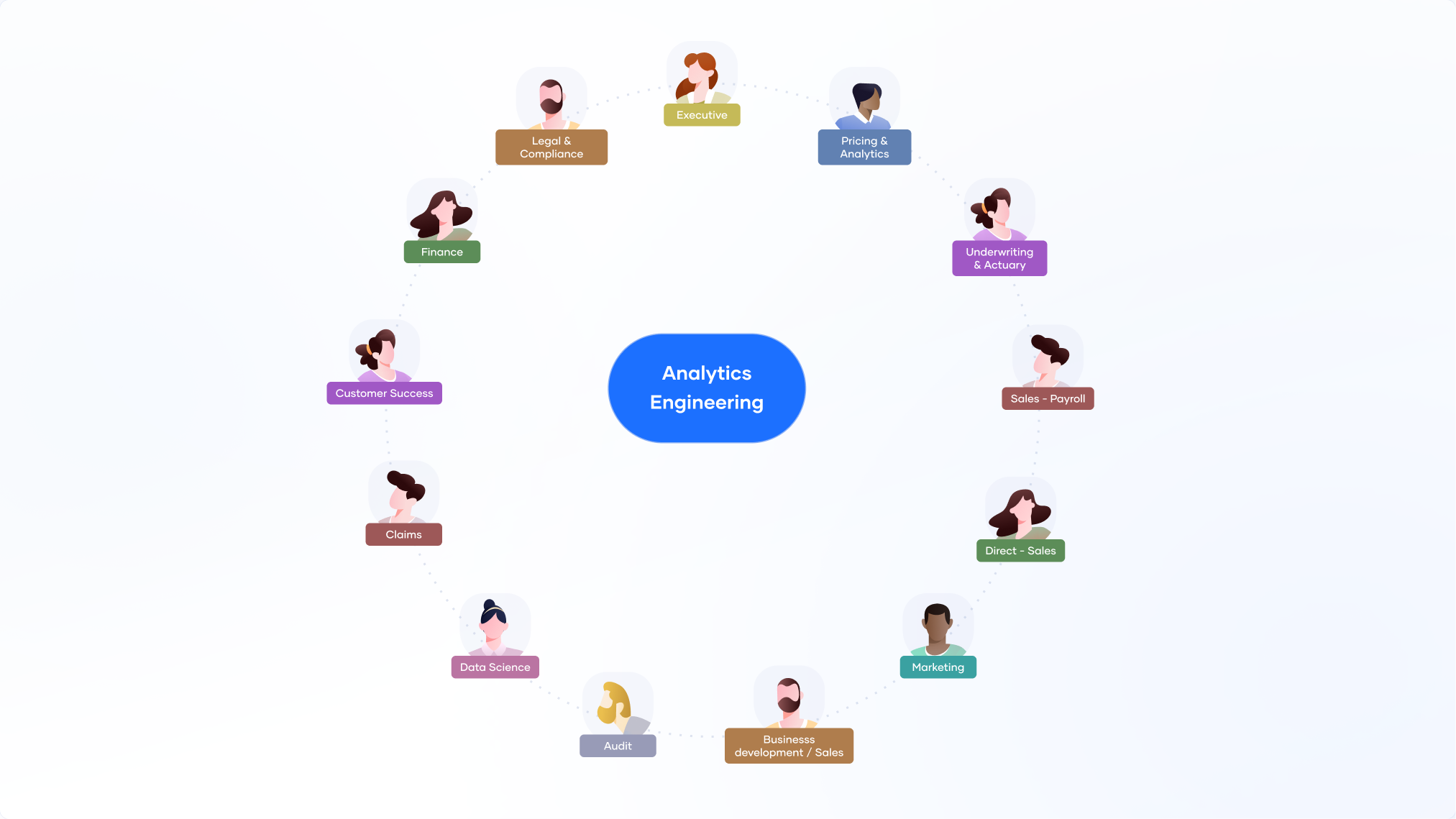
Recognizing that trust in the warehouse was non-negotiable, Ed developed a vision for Pie’s data teams that included leaning into data observability and data governance. Once the foundational data elements were in place then the next step was to establish a hybrid analytics approach using a “Center of Excellence” model. The goal was to provide a structured and efficient way to manage data and analytics resources, balancing centralization with distributed analytics across business units. The end result was better decision-making throughout the organization by empowering analysts from across business units to address their specific needs in a self-service manner.
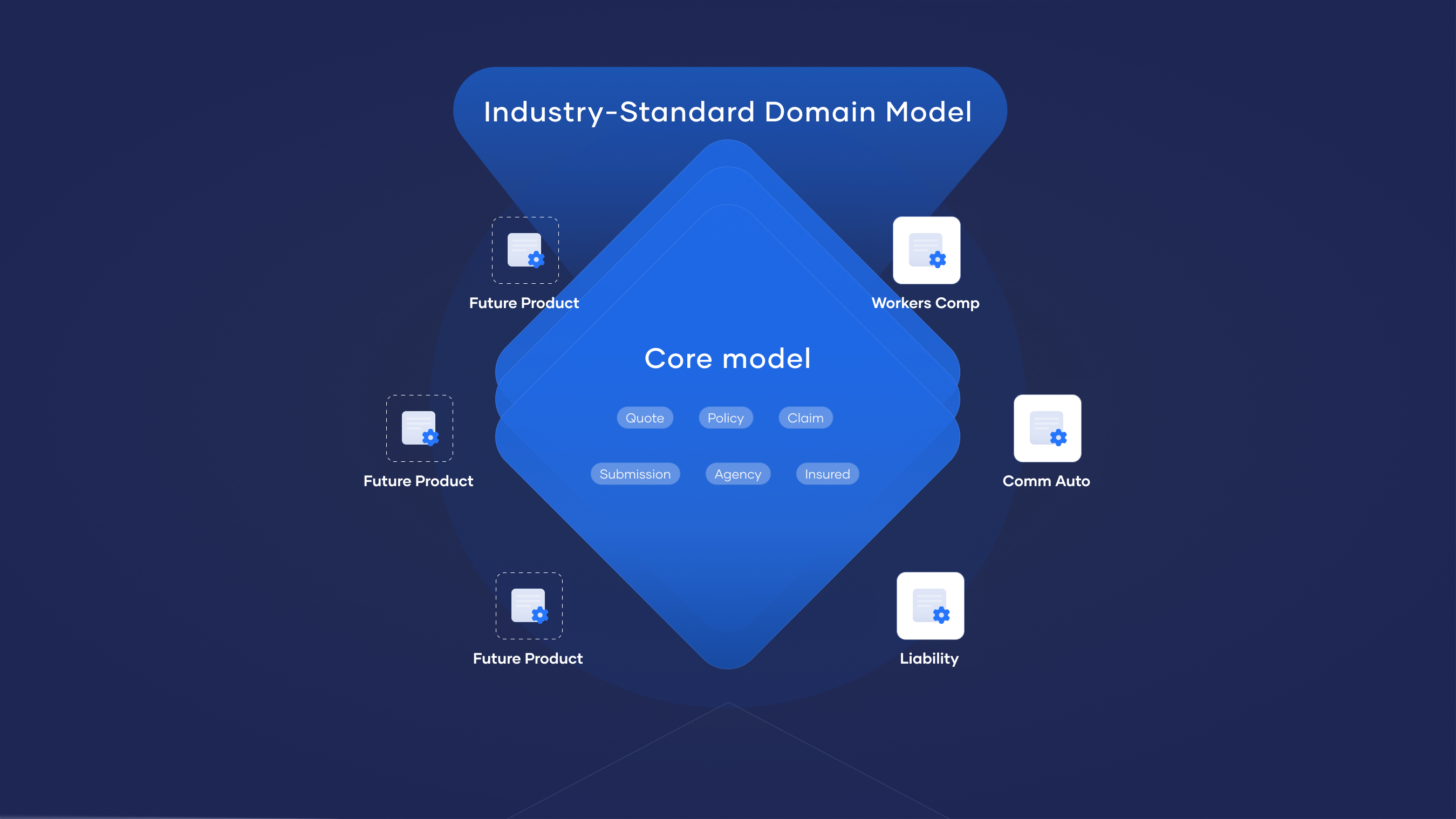
Working with fellow data architects and engineers, Ken spearheaded the effort to rearchitect and replace Pie’s older, unreliable Enterprise Data Warehouse (EDW 1.0) with an improved EDW 2.0. This transformation centered on introducing a logical, domain-driven industry-standard data model. The team realized that while many available insurance industry-standard models are physical in nature—meant primarily to shortcut the design of an insurance management system—they failed to capture the true meaning of data for the business. Pie needed a model that could document and define core business data elements. By defining this logical, domain-centric model first, the team established the foundational language for Pie’s entire data strategy, enabling any necessary physical data implementation to be designed from this single source of truth.
The team designed this new industry-standard model as a logical representation of core insurance entities common across most Property & Casualty (P&C) businesses. This structure features a central set of common entities that adhere to universal data relationship rules for policy-related data. This core framework ensures scalability, acting as the central hub into which product-specific data entities can seamlessly plug. The result is a highly flexible and extensible business domain data model capable of supporting the entire enterprise.
This architectural shift was driven by a guiding philosophy: The business is the data. The team understood that quality business support systems cannot be designed without a profound understanding of the underlying business data. This philosophy moved them away from patchwork solutions. Instead, the data engineering group focused on designing a unified, enterprise-wide model that could grow with the company. For instance, when Pie launched Commercial Auto insurance as a new line of business, the team simply extended the core model rather than starting from scratch. This forward-thinking design significantly reduced friction, saved development time, and accelerated the time-to-market for reporting and analytical foundations.
Prior to the release of the new Enterprise Data Warehouse (EDW2), business stakeholders questioned the accuracy of reports, making it hard to rely on data for strategic decisions. With the release of EDW2, Data Engineering established a “certification” process for new health-of-the-business Looker dashboards that were released and highly trusted by the business. Also through training and knowledge-share, a Hybrid (Center of Excellence) analytics model was established that empowered analysts from across the organization to build new dashboards confidently without hand-holding. As Ken put it: “We don’t want to be a bottleneck. It’s about teaching people to fish.”
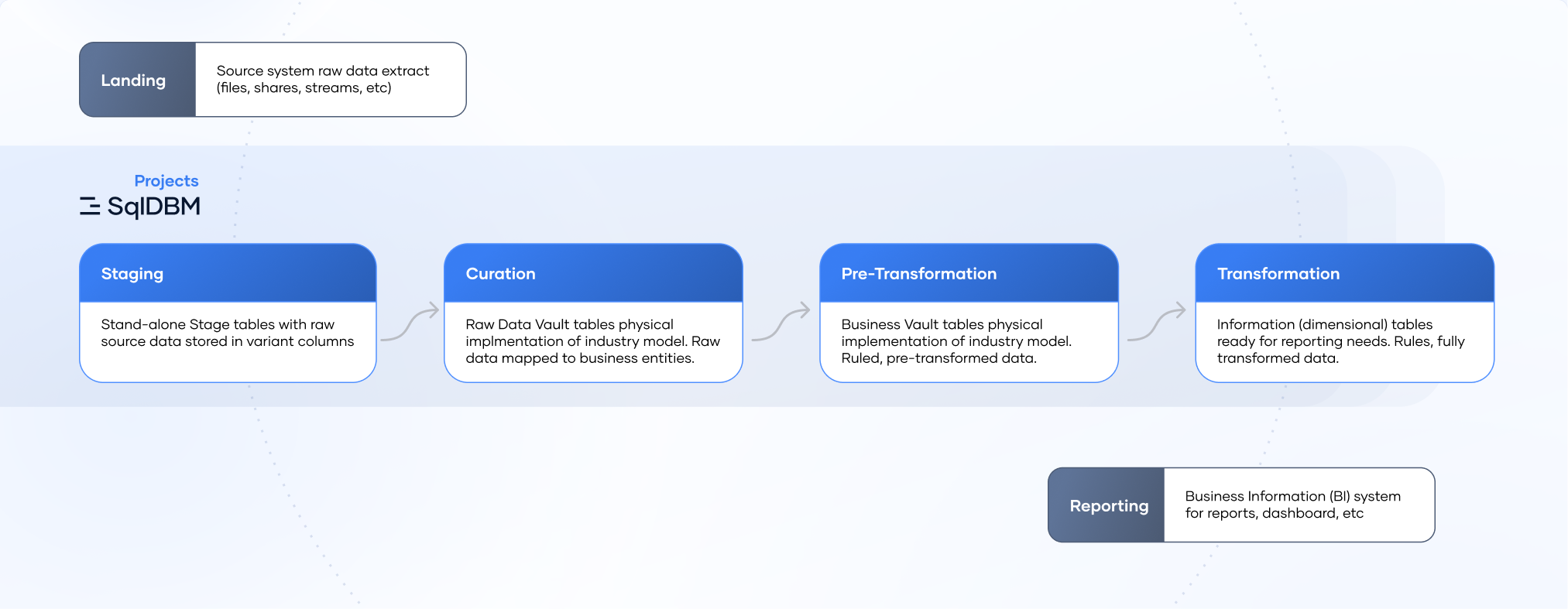
To bring improvements to Pie’s EDW2 data model to life, the data engineering team leaned on SqlDBM. The platform didn’t just solve the problem for them, it enabled them to execute their strategy:
The end result was a transformation of EDW2 from a source of doubt into a trusted foundation for business growth and SqlDBM was a key factor in making it happen.
The results of Pie Insurance’s data warehouse were clear, it transformed Pie’s business and anchored Pie’s prescriptive and predicative analytics. Here are some of the key points:
When Pie launched Commercial Auto alongside its core Workers’ Compensation offering, the data team didn’t have to start from scratch. Thanks to Pie’s core industry-standard model, they simply extended the framework, enabling faster reporting and analytics across multiple business lines. What could have taken months was reduced to weeks.
In the insurance space, many core functions like claims are handled through specialized vendors. Pie initially worked with Corvel, then transitioned to Origami. With a robust data model in place, the switch was virtually plug-and-play. This strategy of building standards meant the data model “didn’t miss a beat”, according to Ed.
Perhaps the most critical outcome: executives and business stakeholders now trust the numbers they see. As Ed explained, before the transformation, reports weren’t widely believed. Now, decisions about loss ratios, growth trends, and even IPO-readiness rest on a foundation of accurate, consistent data.
By empowering analysts across the org with patterns and guidance, Ed and Ken avoided the trap of becoming bottlenecks. SqlDBM’s collaborative modeling environment supported this vision, giving visibility and clarity while maintaining governance. Leadership trusts the data and has a clear view of the health-of-the-business
SqlDBM facilitated collaboration, allowed for industry-standard design, and provided agility with governance, enabling Pie to execute its data strategy. Its versioning and visualization features support a balance between development speed and oversight, allowing data engineers to move quickly while maintaining governance.
The transformation wasn’t just technical. It was cultural. Pie Insurance shifted from “data as a burden” to “data as the product”, a mindset led by Pie’s data engineering team with an assist from SqlDBM.
Metcash Limited, one of Australia’s largest distribution and wholesale companies, sits at the center of a sprawling supply chain that spans food, liquor, and hardware. As the backbone behind thousands of retail stores and independent business partners…
At Pie Insurance, growth isn’t just about policies – it’s about data. In the world of insurtech, data is the product. Every decision, from underwriting to claims management to new business expansion, depends on accurate, trusted, and accessible data everywhere…
John Holland Group, one of the largest infrastructure construction firms in Australia with operations across New Zealand and Singapore, manages over 70 years of historical data. By 2023, the organization faced growing demand for advanced analytics, governance…
Our site uses cookies to support its functionality and personalize the user experience. The following types of cookies are used:
Lorem ipsum dolor sit amet, consectetur adipiscing elit. Ut elit tellus, luctus nec ullamcorper mattis, pulvinar dapibus leo.

The Data Warrior, Strategic Advisor, Data Vault Master, Author, Speaker, and Tae Kwon Do Grandmaster

Leading organizations through analytics transformations, preference for social missions, healthcare, energy, education, and civic engagement
Develop data models collaboratively in the cloud and share them with your organization in various modeling styles and formats with no coding or conversion required
Create and manage business metadata using a dedicated project role
Track and get notified of schema changes in live database environments